801 D4 Signature
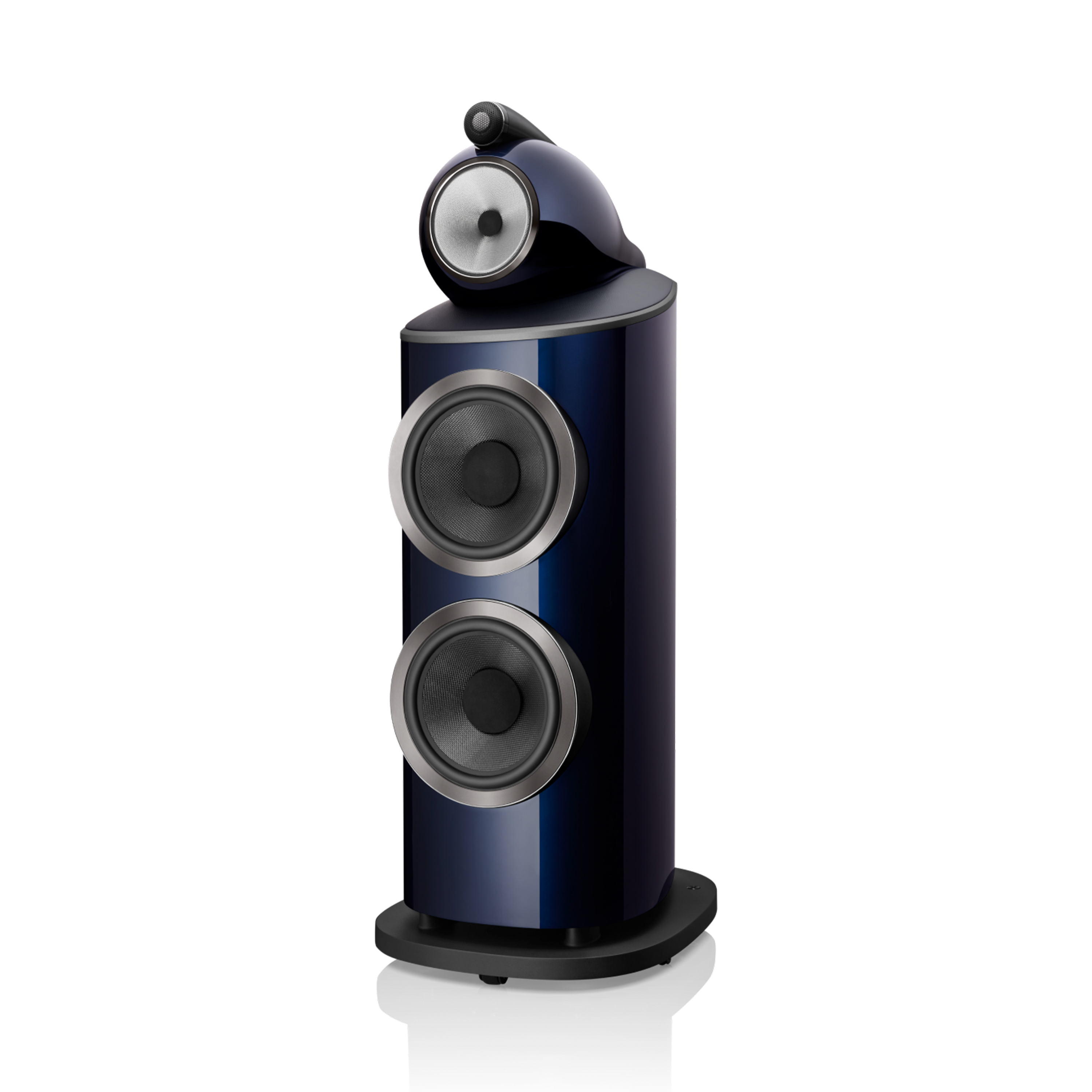
An 800 Series Signature floor-standing three-way with a 25mm Diamond HF driver, 150mm Continuum FST MF driver, dual 250mm Aerofoil LF drivers, separate Turbine Head and upgraded crossover.
- Drivers
- 2 × 250mm LF + 150mm MF + 25mm HF
- Frequency range
- 13Hz–35kHz (-6dB)
- Recommended amplifier power
- 50–1,000W into 8 ohms
Product Overview
The 801 D4 Signature is a passive floor-standing loudspeaker in the 800 Series Signature, introduced by Bowers & Wilkins in 2023. Its three-way vented system combines a 25mm Diamond-dome HF driver, 150mm Continuum FST-cone MF driver and two 250mm Aerofoil Profile-cone LF drivers. Bowers & Wilkins specifies a 13Hz–35kHz (-6dB) frequency range and 90dB sensitivity.
It retains the core architecture of the 801 D4 while adding a Signature HF grille, optimised aluminium top section, rear-mounted crossover arrangement and upgraded components. The HF driver occupies a Solid Body Tweeter-on-Top housing, the MF driver sits in a separate Turbine Head, and the LF enclosure combines Reverse Wrap geometry with Matrix bracing.
Specifications
- System
- Three-way vented-box passive loudspeaker
- Drivers
- LF: 2 × 250mm Aerofoil Profile cones; MF: 150mm Continuum FST cone; HF: 25mm Diamond dome
- Frequency range
- 13Hz–35kHz (-6dB)
- Frequency response
- 15Hz–28kHz (±3dB on reference axis)
- Sensitivity
- 90dB SPL (2.83Vrms, 1m, on axis)
- Harmonic distortion
- Second and third harmonics: below 1% from 30Hz–20kHz and below 0.3% from 100Hz–20kHz, at 90dB/1m/on axis
- Impedance
- 8 ohms nominal, 3.0 ohms minimum
- Recommended amplifier power
- 50–1,000W into 8 ohms on unclipped programme
- Dimensions
- 1,221 × 451 × 600mm (H × W × D)
- Weight
- 100.6kg per loudspeaker
- Finishes
- Midnight Blue Metallic or California Burl Gloss
Design & Technology
Solid Body Tweeter-on-Top
The 25mm Diamond-dome HF driver occupies an elongated machined-aluminium enclosure. Its rear tube loading and separation from the main cabinet manage rear radiation from the diaphragm and vibration transmitted by the main enclosure. The Signature version also uses a revised grille in front of the HF driver.
Turbine Head and Continuum FST MF
The 150mm Continuum FST MF driver is mounted in an aluminium Turbine Head separated from the LF cabinet. Its outer edge uses FST and Biomimetic Suspension rather than a conventional roll surround to control the diaphragm boundary within the dedicated MF band. The separate head also isolates the MF rear volume and external geometry from the LF section.
Dual 250mm Aerofoil LF drivers
The LF section uses two Aerofoil Profile cones with radially varying thickness. The vertically arranged drivers operate in a vented enclosure with a rear Flowport. Moving HF and MF into separate housings leaves the main cabinet focused on LF volume and structural reinforcement.
Reverse Wrap and Matrix
The main enclosure uses Reverse Wrap construction, curving a continuous panel around the front, with a lattice-like Matrix structure inside. The D4 generation adds vertical and horizontal aluminium sections to the Matrix and aluminium reinforcement around the Flowport at the base. The curved outer shell and internal lattice work together to support the LF enclosure.
Signature aluminium top section
The Signature version uses an optimised aluminium section at the top of the LF enclosure, reinforcing both the Turbine Head mounting area and the cabinet top. Midnight Blue Metallic is paired with blue Connolly leather, while California Burl Gloss uses black leather.
Mounted on a rear aluminium spine
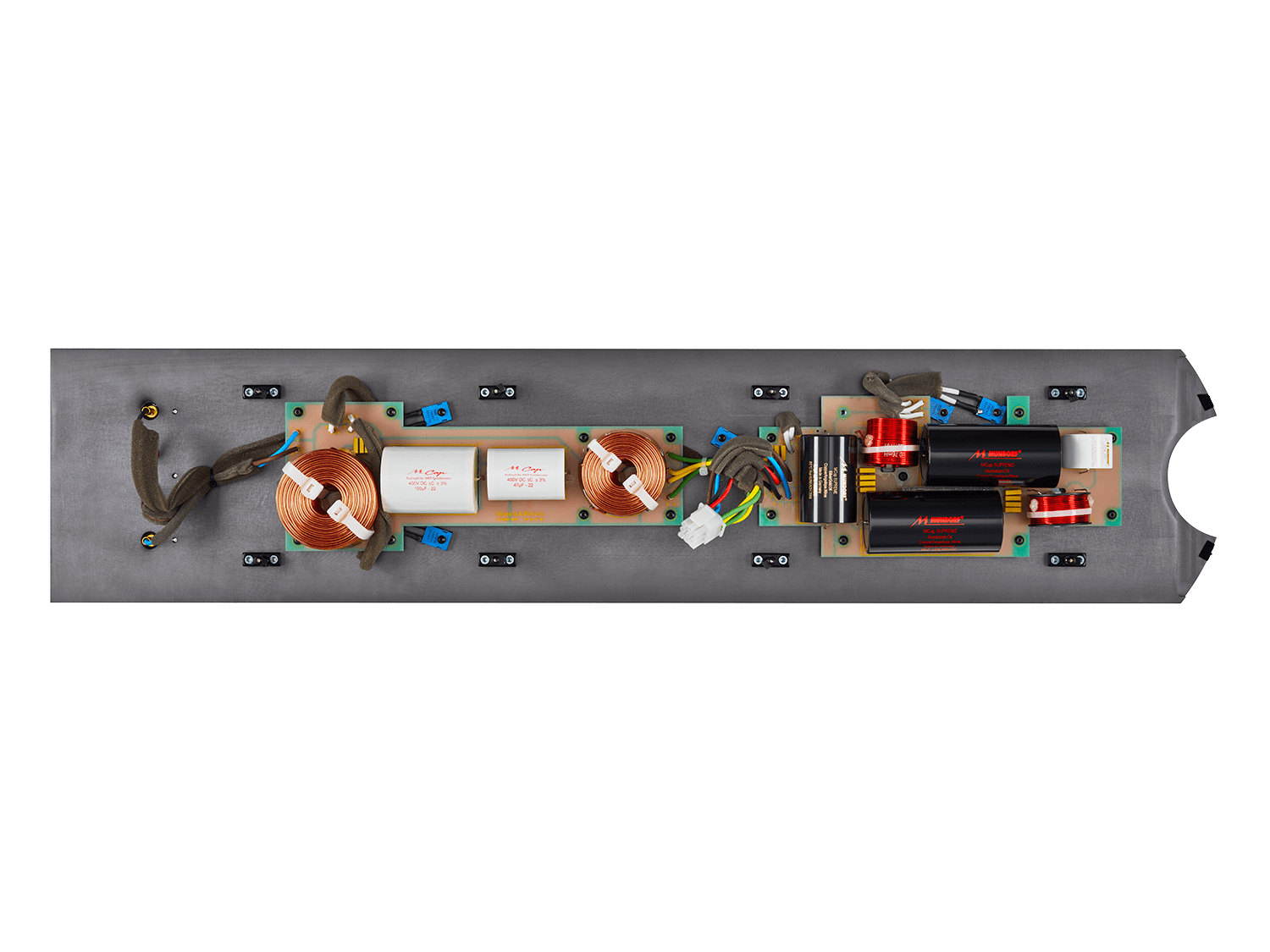
The crossover boards are mounted to an aluminium spine on the rear of the main enclosure. This moves the components away from internal cabinet pressure and uses the aluminium member as a heat-dissipating surface. The Signature version updates the component set, including capacitors and inductors.
Passive architecture for external amplification
With no internal amplifier or DSP, a passive network divides the signal among LF, MF and HF. Nominal impedance is 8 ohms but falls to a 3.0-ohm minimum, and Bowers & Wilkins recommends 50–1,000W of amplification into 8 ohms. Amplification and room integration are therefore configured externally in a conventional high-end HiFi system.
Sources
- 01Bowers & Wilkins801 D4 Signature
Manufacturer product page · Accessed August 15, 2026
- 02Bowers & Wilkins801 D4 Signature Information Sheet
Official datasheet · Accessed August 15, 2026
- 03Bowers & Wilkins801 D4 / 802 D4 / 803 D4 Manual
Official manual · Accessed August 15, 2026
- 04Bowers & WilkinsThe Story of Signature
Manufacturer technology page · Accessed August 15, 2026
- 05Bowers & WilkinsExcellence. Evolved. 800 Series Diamond Engineering
Manufacturer technology page · Accessed August 15, 2026