8c
A three-way active loudspeaker combining an 8-inch acoustic-cardioid MF driver, dual rear 8-inch LF drivers, a 1-inch HF driver, 1,000W total amplification and RoomMatching.
- Drivers
- 2 × 8in LF + 8in MF + 1in HF
- Frequency response
- 30Hz–20kHz (±1dB)
- Amplification
- 500W LF + 250W MF + 250W HF
Product Overview
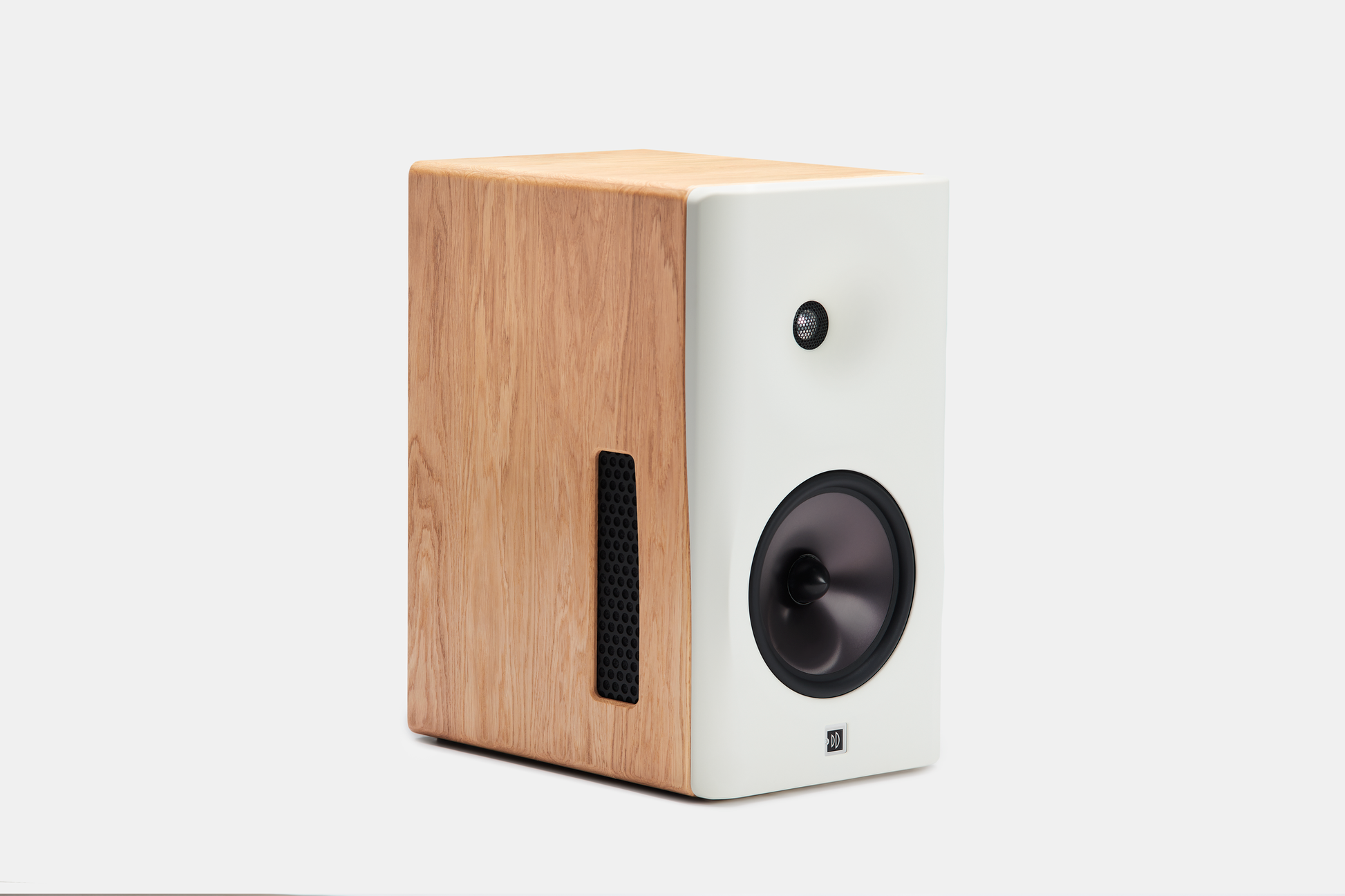
The 8c is a three-way active loudspeaker introduced by Dutch & Dutch in 2018. It combines a front-mounted 8-inch MF driver and 1-inch alloy-dome HF driver with two rear-mounted 8-inch LF drivers. Class D amplification provides 500W for LF and 250W each for MF and HF. Dutch & Dutch recommends it both for high-end home HiFi and as a main monitor in recording and mastering studios.
Its system concept combines an acoustic cardioid to control radiation above 100Hz, Boundary Coupled Bass that uses the front wall as part of low-frequency radiation, and RoomMatching DSP for placement and room-response adjustment. Connectivity includes analogue XLR and AES3, Ethernet control, Roon and Spotify Connect.
Specifications
- System
- Three-way active loudspeaker
- Drivers
- LF: 2 × 8in aluminium cones; MF: 8in aluminium cone; HF: 1in aluminium/magnesium alloy dome
- Enclosure type
- LF: sealed; MF: passive acoustic cardioid; HF: waveguide
- Frequency response
- 30Hz–20kHz (±1dB)
- Crossovers
- 100Hz and 1.25kHz, fourth-order Linkwitz-Riley, linear phase
- Maximum linear SPL
- 106dB continuous at 1m from 35Hz upwards
- Amplification
- LF: 500W; MF: 250W; HF: 250W; Class D
- Analogue input
- Balanced XLR, +4dBu/-10dBV sensitivity, +24dBu maximum
- Digital I/O
- AES3 input and AES3 loop-through output over XLR
- Network
- Ethernet (RJ45), Ascend, Roon, Spotify Connect and firmware updates
- Subwoofer output
- DSP-controlled analogue output
- Recommended front-wall distance
- 10–50cm from the rear of the loudspeaker
- Dimensions
- 485 × 270 × 380mm (H × W × D)
- Weight
- 26kg per loudspeaker
- Cabinet
- 19mm solid-oak outer panels, 18mm birch-plywood internal structure and damped injection-moulded ABS outer baffle
Design & Technology
Three-way system with front MF/HF and rear LF
The front baffle carries an 8-inch MF driver and a waveguide-loaded 1-inch HF driver, while two 8-inch LF drivers operate from a sealed rear section. Crossovers are set at 100Hz and 1.25kHz, with dedicated Class D amplification and DSP for each band. Moving LF to the rear leaves the front surface available for the MF/HF system and its directivity-forming geometry.
Acoustic cardioid above 100Hz
The rear radiation of the 8-inch MF driver exits through resistive side vents and combines with the forward radiation to form a passive acoustic cardioid with reduced rear output. The MF section covers 100Hz to 1.25kHz and hands over to the HF waveguide. The enclosure and vents therefore form part of the radiation system rather than relying on electrical delay alone.
Boundary Coupled Bass using the front wall
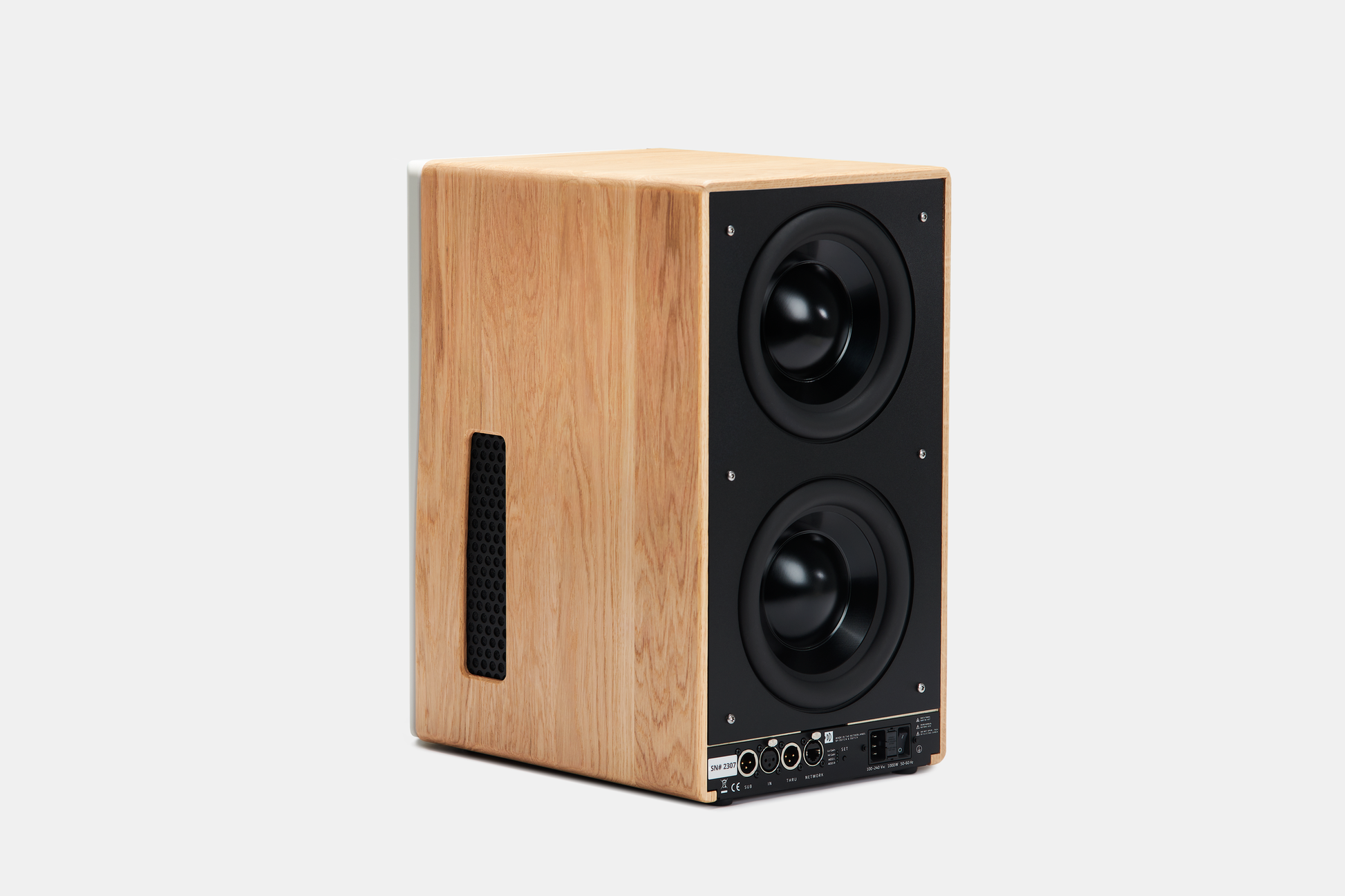
The two rear LF drivers operate below 100Hz and are intended to couple acoustically to the front wall with the loudspeaker placed 10 to 50cm away. The boundary-distance setting aligns the combined loudspeaker/wall bass radiation with the MF cardioid and adjusts its level. Rather than moving the loudspeaker away to avoid boundary interaction, the design deliberately uses the front wall as part of the low-frequency system.
RoomMatching
RoomMatching combines front-wall distance settings with room-response EQ. Integration with REW (Room EQ Wizard) allows filters based on room measurements to be applied to the 8c. Placement and room-mode adjustments are therefore handled by the loudspeaker's internal DSP rather than an external processor.
Ascend and continuing feature updates
Ascend manages input, volume, RoomMatching and Voicing from web, iOS and Android applications. Ethernet is also used for streaming and firmware updates, and current firmware supports Roon and Spotify Connect. Dutch & Dutch has continued to add functions through firmware after the product's introduction.
Analogue, AES3 and network connectivity
The balanced XLR input offers +4dBu and -10dBV sensitivity settings, while AES3 can be looped from the first loudspeaker to the second. A DSP-controlled analogue output is provided for an external active subwoofer. Ethernet carries Ascend control and network streaming.
Oak exterior and birch-plywood internal structure
The top and side panels use 19mm solid oak, the internal partitions and bracing use 18mm birch plywood, and the outer front baffle is damped injection-moulded ABS. The exterior, sealed LF volume, MF side vents and front waveguide are combined in one compact enclosure.
Sources
- 01Dutch & Dutch8c Next-Generation Loudspeaker System
Manufacturer product page · Accessed August 15, 2026
- 02Dutch & Dutch8c Specifications
Official datasheet · Accessed August 15, 2026
- 03Dutch & Dutch8c Setup Guide
Official manual · Accessed August 15, 2026
- 04Dutch & Dutch8c Placement and Boundary Coupled Bass
Manufacturer technology page · Accessed August 15, 2026
- 05Dutch & Dutch8c Firmware
Manufacturer technology page · Accessed August 15, 2026
- 06Dutch & DutchDutch & Dutch Pushes the Boundaries of Audio System Design
Manufacturer press release · Accessed August 15, 2026