ULTRA-X40
A self-powered point source integrating concentrically arranged dual 8-inch LF drivers and a 3-inch HF driver, a rotatable Constant-Q horn, 1,950W peak three-channel amplification and GEN-1.
- Drivers
- 2 × 8in LF + 3in HF
- Coverage
- 110° × 50° (rotatable)
- Linear peak SPL
- 132.5dB (M-noise)
Product Overview
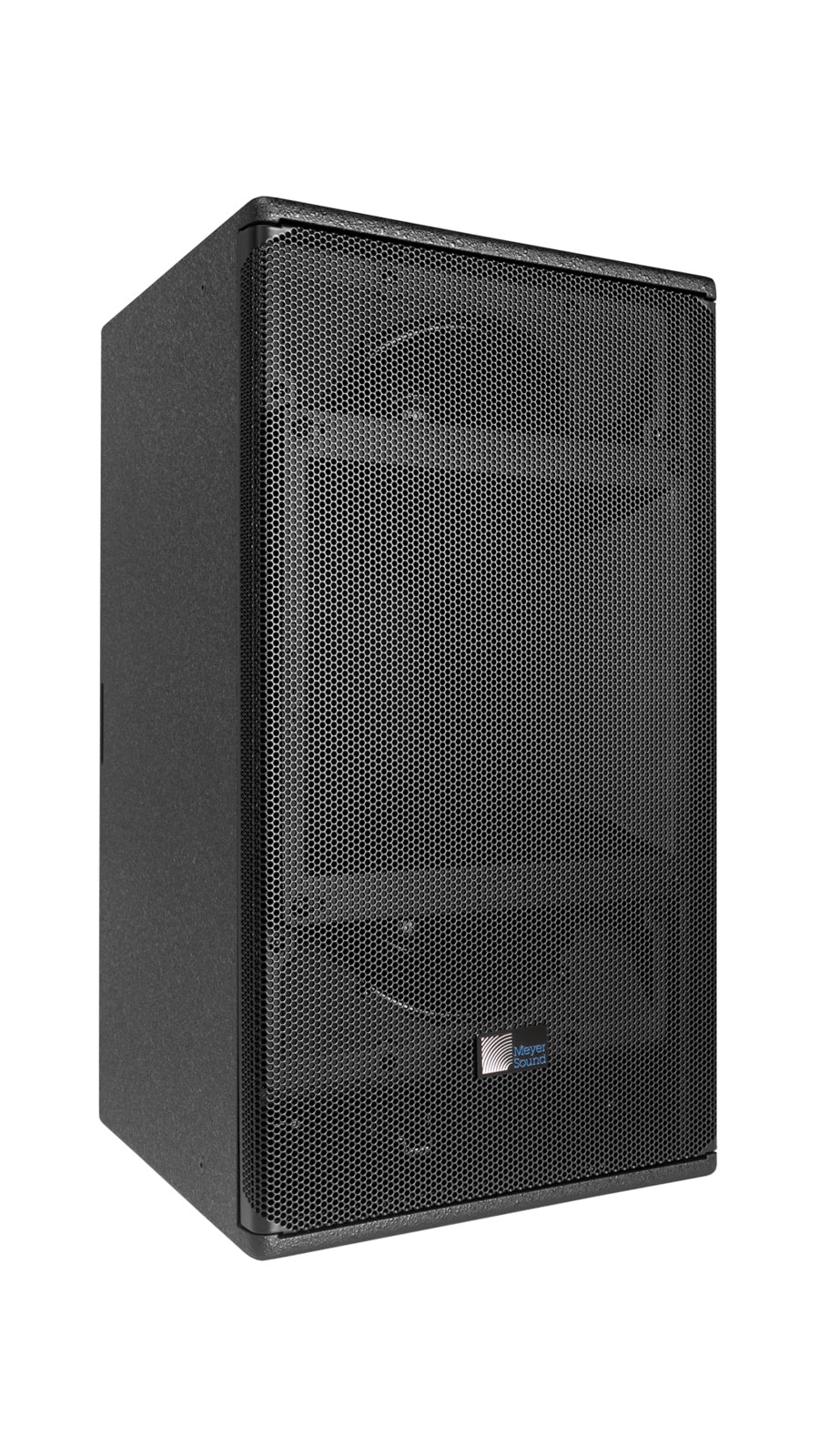
The ULTRA-X40 is a two-way self-powered point-source PA loudspeaker introduced by Meyer Sound in 2019. It combines two 8-inch LF drivers with a 3-inch-diaphragm HF compression driver coupled to a rotatable 110° × 50° Constant-Q horn. Meyer Sound specifies it for portable PA as well as installed applications including theatres, concert halls, houses of worship, clubs, stadiums, under-balcony systems and front fills.
A three-channel Class D amplifier rated at 1,950W peak is integrated with signal processing for crossover, phase and frequency correction, and driver protection. The current 2026 configuration supports GEN-1 (Galileo Extended Networking), adding Milan AVB and AES67 network audio alongside analogue input, with configuration and monitoring through Nebra.
Specifications
- System
- Two-way self-powered point-source PA loudspeaker
- Drivers
- LF: 2 × 8in cone drivers; HF: 1 × 3in-diaphragm compression driver
- Acoustical principle
- Vented (bass reflex)
- Operating frequency range
- 55Hz–19.5kHz
- Frequency response
- 56Hz–19kHz (±4dB, free field at 4m, 1/3-octave resolution)
- Phase response
- ±45° from 90Hz to 19.5kHz
- Maximum SPL
- 138dB (measured with noise in free field at 4m and referred to 1m)
- Linear peak SPL
- 132.5dB (M-noise, 18dB crest factor)
- Coverage
- 110° × 50°, rotatable Constant-Q horn
- Amplification
- Three-channel Class D, 1,950W peak total
- Signal processing
- Electronic crossover, phase/frequency correction and driver protection
- Audio inputs
- Analogue, Milan AVB and AES67 (GEN-1)
- GEN-1 processing
- 10-band parametric EQ, U-Shaping, delay, Product Integration and atmospheric correction
- Network control
- Configuration, status monitoring and telemetry through Nebra
- Dimensions
- 567 × 318 × 356mm (H × W × D; 391mm deep including handles)
- Weight
- 23.6kg per loudspeaker
- Cabinet
- Multi-ply birch, trapezoidal enclosure, perforated steel grille
- Mounting and rigging
- 11 × M8 rigging points and 35mm pole socket with M20 thread
Design & Technology
Two-way self-powered configuration
The two-way system uses two 8-inch LF drivers and one 3-inch-diaphragm HF compression driver. A three-channel Class D amplifier drives both LF units and the HF section separately, with 1,950W total peak output. Crossover, phase/frequency correction and driver protection are also integrated into the enclosure.
Concentric driver and waveguide arrangement

The two LF drivers are arranged above and below a low-mid waveguide that surrounds the HF compression driver and horn. Meyer Sound states that this concentric arrangement forms point-source radiation and extends directional control down to 400Hz.
Rotatable Constant-Q horn
The ULTRA-X40 uses a 110° × 50° Constant-Q horn that can be rotated for vertical or horizontal deployment. The companion ULTRA-X42 provides a narrower 70° × 50° pattern for applications requiring more controlled coverage.
Integrated DSP
Internal processing handles the electronic crossover, phase and frequency correction filters, and driver protection. The datasheet specifies acoustic phase response within ±45° from 90Hz to 19.5kHz.
GEN-1 networking and endpoint processing
The current 2026 configuration incorporates GEN-1 (Galileo Extended Networking). It accepts analogue, Milan AVB and AES67 inputs, while moving functions traditionally handled by an external processor into the loudspeaker, including 10-band parametric EQ, U-Shaping, delay, Product Integration and atmospheric correction.
Configuration and monitoring through Nebra
GEN-1 is configured through Meyer Sound's Nebra software, which manages loudspeakers across the network. Telemetry reports operating information including signal presence, clipping and limiter status.
Portable and installed applications
As a point-source loudspeaker, it supports pole mounting, floor placement, vertical or horizontal suspension, and multi-cabinet clusters. Meyer Sound lists concert halls, theatres, houses of worship, clubs, theme parks and stadiums, as well as front fill, under-balcony and compact voice-reinforcement systems.
Enclosure and rigging
The vented trapezoidal enclosure is made from multi-ply birch and protected by a perforated steel grille. It provides 11 M8 rigging points, a 35mm pole socket with M20 thread and a removable handle, with dedicated accessories including U-brackets, yokes and cluster plates. Weather protection and custom colours are optional.
Sources
- 01Meyer SoundULTRA-X40 Point Source
Manufacturer product page · Accessed August 15, 2026
- 02Meyer SoundDatasheet - ULTRA-X40
Official datasheet · Accessed August 15, 2026
- 03Meyer SoundOperating Instructions - ULTRA-X40
Official manual · Accessed August 15, 2026
- 04Meyer SoundGEN-1 - Galileo Extended Networking
Manufacturer technology page · Accessed August 15, 2026
- 05Meyer SoundMeyer Sound Previews an Entirely New Point Source Loudspeaker Design at ISE
Manufacturer press release · Accessed August 15, 2026
- 06Meyer SoundMeyer Sound Highlights Next-Generation Integrated Solutions at NAMM and ISE 2026
Manufacturer press release · Accessed August 15, 2026