LS LUXE
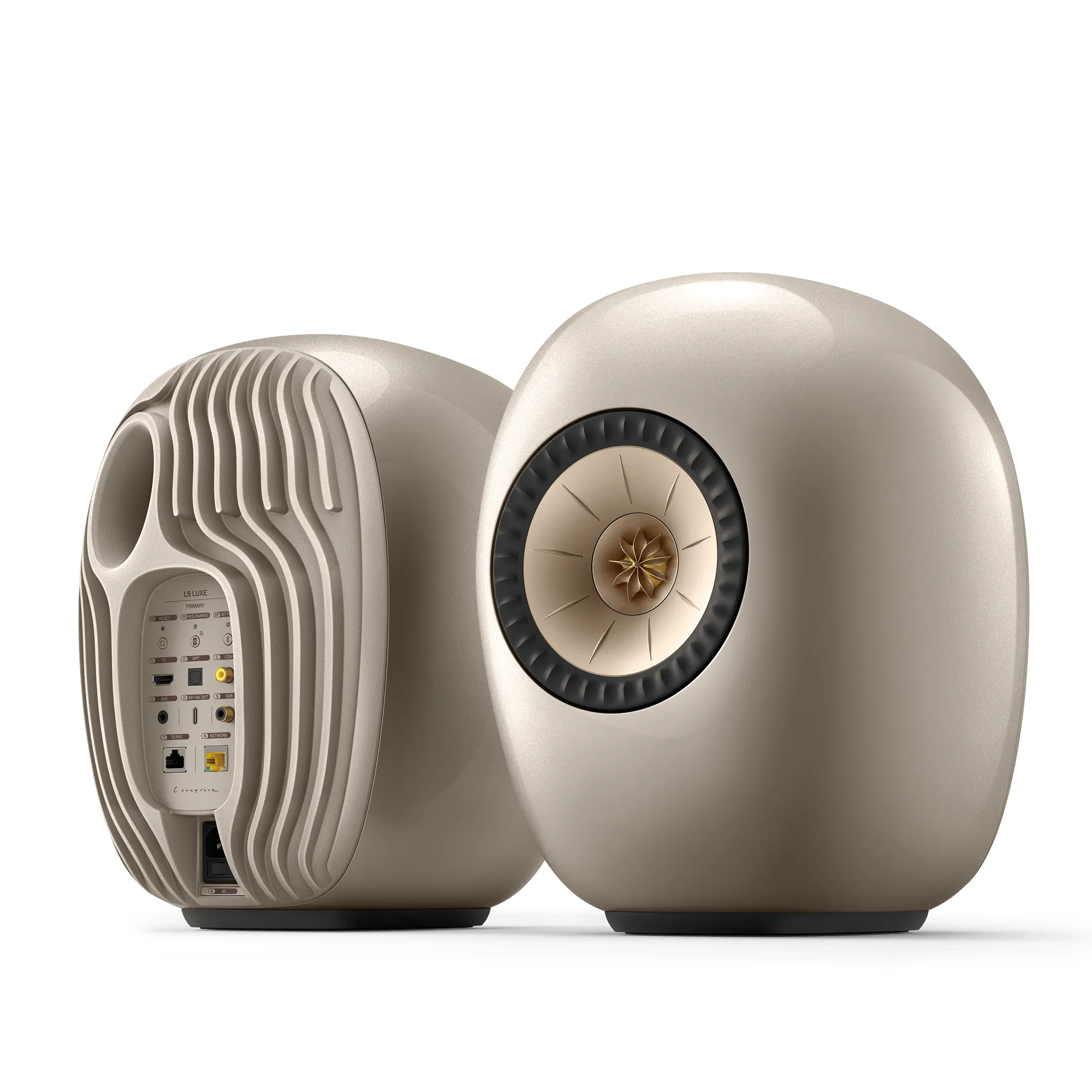
KEF's flagship two-way wireless active speaker, integrating a 6.5-inch Uni-Q array, MAT and VECO.
- Drive units
- 6.5-inch Uni-Q + MAT
- Frequency range
- 35Hz–47kHz (-6dB)
- Amplification (per speaker)
- 280W Class D + 100W Class AB (each)
Product Overview
LS LUXE is a two-way wireless active loudspeaker system that brings streaming, source selection, digital conversion, DSP, amplification and the drive units into a stereo pair. KEF positions it as the flagship of its two-way wireless range, introducing a larger 6.5-inch Uni-Q array and Velocity Control Technology (VECO) above the LS50 Wireless II.
The important change is system integration rather than a longer feature list. The drive unit, amplifiers, motion sensor, DSP and enclosure have been developed as one controlled system. It retains KEF's W2 platform and KEF Connect app, but separates itself from the LS50 Wireless II through greater low-frequency capacity, closed-loop cone control and a cabinet in which industrial and acoustic design are closely linked.
Specifications
- System type
- Two-way wireless active loudspeaker system (pair)
- Drive units
- 12th-generation Uni-Q: 165mm aluminium LF/MF cone and 25mm vented aluminium dome with MAT
- Frequency response
- 42Hz–28kHz (±3dB at 85dB/1m; dependent on EQ settings)
- Frequency range
- 35Hz–47kHz (-6dB at 85dB/1m; dependent on EQ settings)
- Maximum output
- 110dB at 1m
- Amplification (per speaker)
- LF/MF: 280W Class D; HF: 100W Class AB
- Supported resolution
- Network up to 384kHz/24-bit; optical 96kHz/24-bit; coaxial and HDMI eARC 192kHz/24-bit
- Interspeaker link
- Wireless at 96kHz/24-bit PCM; wired Ethernet at 192kHz/24-bit PCM
- Physical inputs
- HDMI eARC, optical, coaxial, 3.5mm analogue and Ethernet
- Wireless
- Dual-band Wi-Fi 6, Bluetooth 5.3, AirPlay, Google Cast and UPnP
- Dimensions (each)
- 336 × 223 × 298mm (H × W × D)
- Weight
- 20kg per pair
- Finishes
- Eclipse Black, Mineral White and Dusk Titanium
Design & Technology
A 6.5-inch two-way Uni-Q
The acoustic core is a 12th-generation 6.5-inch Uni-Q array. A 25mm tweeter sits at the acoustic centre of the 165mm LF/MF cone, aligning their radiation over a wide operating range. Compared with the 5.25-inch Uni-Q in the LS50 Wireless II, the radiating area is larger; KEF's white paper also describes an enclosure volume roughly 50 per cent greater.
A BMC enclosure approaching a sphere
Ross Lovegrove's form is not solely decorative. Glass-fibre-reinforced bulk moulding compound allows KEF to remove sharp edges and steps around the driver and move the radiation geometry closer to a sphere, with the stated aim of reducing diffraction. The material's strength limits the volume needed for internal bracing, while the rear aluminium heat sink and flared port are integrated into the enclosure architecture.
Metamaterial Absorption Technology (MAT)
MAT routes the tweeter's rear radiation through a disc containing a network of tuned channels, reducing the energy reflected back towards the diaphragm. KEF states that it absorbs 99 per cent of unwanted rear sound. That figure is KEF's own characterisation and is not presented here as an independent measurement.
Velocity Control Technology (VECO)
VECO is a closed-loop system that senses the LF/MF cone's velocity electromagnetically and feeds that signal back to the current-drive amplifier, correcting the difference between the intended and actual diaphragm motion. KEF's white paper describes a sensing coil printed on a flexible circuit and shows the sensor tracking cone velocity to around 400Hz. LS LUXE is also KEF's first application of VECO to a reflex-loaded loudspeaker.
Current drive and motion feedback
Each loudspeaker contains a 280W Class D stage for LF/MF and a 100W Class AB stage for HF. KEF describes a current-drive approach that regulates voice-coil current from a high output impedance rather than relying on conventional voltage drive. VECO closes the feedback loop around the LF/MF path, making the amplifier and transducer one controlled system rather than two independently specified components.
Music Integrity Engine
Music Integrity Engine is KEF's DSP layer for crossover filtering, phase correction, low-frequency management and room-oriented EQ. KEF Connect exposes settings for wall and desk placement, room character, bass level, treble and subwoofer integration. Because the system is active, its filters and protection can be designed around known drive-unit and amplifier behaviour.
W2 Wireless Platform
Network playback and control use the W2 platform shared with the LS50 Wireless II and LS60 Wireless. It supports AirPlay, Google Cast, Spotify Connect, TIDAL Connect, Qobuz Connect and UPnP, with network input up to 384kHz/24-bit. Roon Ready is explicitly scheduled for 2027 and should therefore be distinguished from features available at launch.
TV, analogue and subwoofer integration
HDMI eARC, optical, coaxial and 3.5mm analogue inputs make the system more than a streaming endpoint. Each speaker has a subwoofer output, with high-pass, low-pass, gain and phase adjustment available through KEF Connect. The speakers can communicate wirelessly or over Ethernet when the higher interspeaker sample rate is required.
Design Notes
What the move from 5.25 to 6.5 inches changes
The LS50 Wireless II uses a 5.25-inch Uni-Q; LS LUXE uses a 6.5-inch array. KEF says the LS LUXE enclosure is roughly 50 per cent larger and reports 8–10dB more acoustic output below 40Hz and 6–14dB less harmonic distortion through the bass and midrange in its own comparison measurements.
Engineering Interpretation
More radiating area and enclosure volume reduce the excursion required for a given output and should increase low-frequency headroom. The meaningful benefit is therefore not simply that LS LUXE plays louder, but that it has more bass margin at practical levels with lower distortion. The published graphs are KEF's measurements, however, not an independent comparison.
Why VECO depends on an active architecture
VECO senses LF/MF cone velocity and returns the signal to a dedicated current-drive amplifier. The sensor, amplifier, drive unit and DSP are engineered together for LS LUXE.
Engineering Interpretation
This is not readily reproduced by adding an external DSP to a passive loudspeaker. The manufacturer can control loop gain, stability, transducer protection and the reflex system's low-frequency alignment, which is a substantive advantage of the active architecture.
An enclosure where form and acoustics are inseparable
Ross Lovegrove shaped an enclosure built from glass-fibre-reinforced BMC, with a rounded perimeter, minimal discontinuity around the driver and an integrated rear heat sink and port.
Engineering Interpretation
The organic form is brand expression, but also a way to coordinate diffraction, internal volume, stiffness, thermal management and port placement. Transferring the surface styling to a conventional box would not preserve the same acoustic architecture.
Position within the LS Wireless range
KEF presents LS LUXE as a step above the LS50 Wireless II and as its flagship two-way wireless loudspeaker. LS60 Wireless remains a slim, three-way floorstanding system with a different architecture.
Engineering Interpretation
LS LUXE is better understood not as a smaller LS60 Wireless, but as a comprehensive redesign of the compact two-way format around premium construction, closed-loop control and industrial design. Its position is defined by format and engineering approach as much as by price.
PRODUCT · 07.31.2026
KEF debuts VECO closed-loop driver control in the LS LUXE
KEF has introduced the LS LUXE wireless active speaker, pairing a 12th-generation 6.5-inch Uni-Q with MAT and the first use of its VECO velocity-feedback system. A dedicated current-drive amplifier corrects cone motion in real time, while the W2 platform handles streaming and room setup.

Sources
- 01KEFLS LUXE | Wireless HiFi Speakers
Manufacturer product page · Accessed August 14, 2026
- 02KEFLS LUXE Information Sheet
Official datasheet · Accessed August 14, 2026
- 03KEFLS LUXE White Paper
Official technical paper · Accessed August 14, 2026
- 04KEFLS LUXE vs LS50 Wireless II: Which Wireless Bookshelf Speaker Should You Choose?
Manufacturer comparison · Accessed August 14, 2026
- 05KEFVelocity Control Technology
Manufacturer technology page · Accessed August 14, 2026
- 06KEFLS50 Wireless II
Manufacturer product page · Accessed August 14, 2026
- 07KEFLS60 Wireless
Manufacturer product page · Accessed August 14, 2026