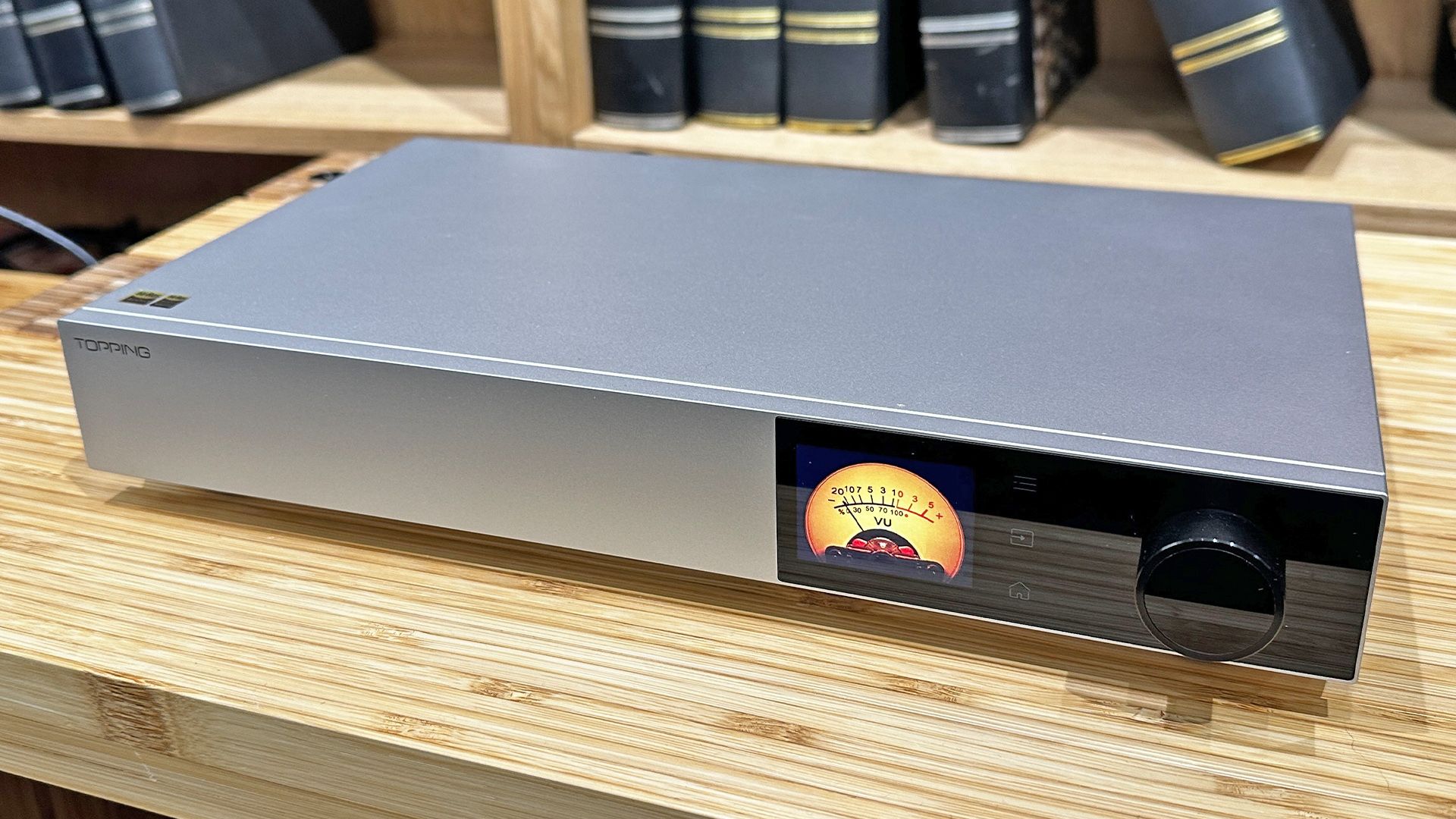
What Hi-Fi? published its review of Topping's flagship D900 D/A converter on August 14. The PSRM, or Precision Stream Reconstruction Matrix, architecture used here and in the less expensive D90MKIII converts the incoming audio stream into a sequence of one-bit pulses whose density represents waveform level. D900 implements it as a fully balanced discrete circuit with 32 high-speed switching voltage references per channel, twice the number used in the D90MKIII.
Inputs comprise two coaxial and two optical connections, USB-B, USB-C, AES/EBU and I²S, plus Bluetooth 5.1 with LDAC and aptX HD. PCM support reaches 32-bit/768kHz and DSD reaches DSD512. Balanced XLR is the only analogue output, selectable between fixed and variable level. Variable mode allows direct connection to a power amplifier or active loudspeakers, while systems without balanced inputs require adapters because there are no RCA sockets.
What Hi-Fi? praised the metal casework and controls, and the built-in parametric equaliser adds useful flexibility. The 2in screen is crisp but difficult to read at a distance. Testing used Naim, Cyrus and MacBook Pro digital sources across systems including ATC SCM50 and Epos ES-14N loudspeakers, with Chord's Qutest and Hugo 2 among the comparison DACs.
The D900 extracted substantial texture and low-level information from complex recordings, tracing small dynamic shifts with unusual fluidity. Its balance was neutral, its image spacious, and its focus remained stable as the music grew dense. Treble combined smoothness with bite and the midrange was notably articulate. Bass reached deep but lacked the tautness and weight of the rivals, while upbeat material exposed a more restrained sense of energy and rhythmic drive than either Chord DAC.
The review rated sound at four stars and features and build at five, placing the D900's resolution, fluidity, file support and construction among the best at the price without calling it a complete all-rounder. Crucially, What Hi-Fi? also cautioned that the audible contribution of PSRM cannot be isolated from the power supply, analogue output stage and the rest of the signal path. D900 is therefore most convincing as a complete converter and variable-level balanced source for an amplifier or active speakers, not as proof of a topology in isolation.