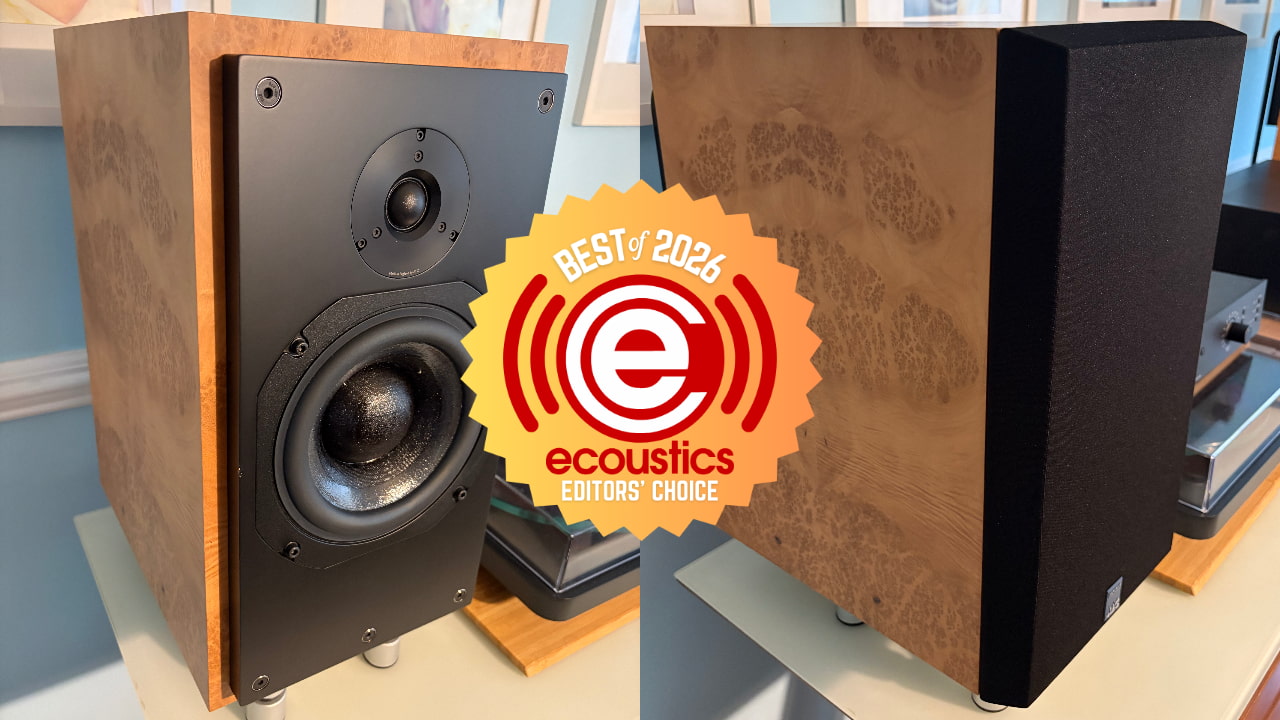
eCoustics published its ATC SCM20ASL review on August 17. The two-way active loudspeaker divides the analogue signal at line level before dedicated amplifiers feed the drivers. It removes the external power amplifier and speaker cables, but still requires an upstream preamplifier, DAC or network player with volume control.
The sealed 20-litre cabinet houses a 6in SB75-150SL Super Linear mid/bass driver and a 1in SH25-76S S-Spec soft-dome tweeter, crossed at 2.2kHz. The mid/bass unit uses a 3in voice coil and ATC's underhung motor architecture, while internal bracing, damping and bitumastic panels reinforce the enclosure. At 53.6lb each, the speakers demand rigid, stable support.
The rear amplifier pack contains two discrete Class A/B MOSFET stages, assigning 200W to the mid/bass driver and 50W to the tweeter. A single balanced XLR is the only input: there is no RCA, USB, HDMI, streaming or Bluetooth. Sensitivity for full output adjusts from 1 to 4Vrms, and a low-frequency shelf offers -2 to +3dB adjustment in 1dB steps for boundary compensation.
eCoustics found that clarity and dynamic presence remained intact at low levels, while higher volumes preserved instrumental separation and fast, controlled bass. The low end combined speed, weight and impact, leading the reviewer to consider a subwoofer unnecessary in most rooms. Vocal and piano texture and image stability were further strengths, while poor recordings and mediocre upstream components received little forgiveness. Soundstage depth was relatively limited in the review system, but the writer attributed at least some of that result to placement constraints rather than the loudspeaker itself.
The reported price is $10,999 per pair. SCM20ASL is not an all-in-one system with wireless services or room correction; it integrates crossover, amplification and proprietary drivers downstream of an XLR analogue input. Its relevance across professional monitoring and domestic playback lies in ATC controlling the amplifier-and-loudspeaker interface as one system from low-level listening to high output.