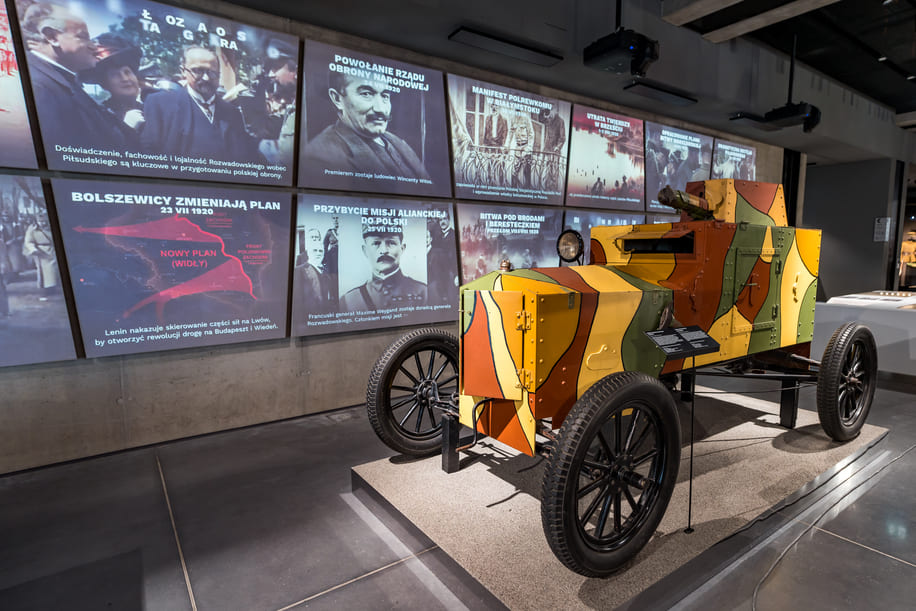
The newly built 1920 Battle of Warsaw Museum in Ossów, Poland, has installed an exhibition-audio system centred on HARMAN Professional technology. Integrator ESS Audio combined FLUX:: SPAT Revolution spatial processing with JBL Professional loudspeakers to make movement through the sound field part of the historical presentation.
SPAT Revolution treats aircraft, cavalry charges, explosions, and troop movements as audio objects that can travel around visitors instead of remaining attached to individual loudspeaker positions. ESS Audio's Mateusz Nawrocki says binaural previews allowed the team to complete most of the spatial mix before arriving on site, reducing commissioning time.
The entrance hall uses JBL CBT 1000 and CBT 70J columns with AC16 loudspeakers and Control SB2210 subwoofers. In the main exhibition hall, 14 Control HST systems, six CBT 70J-1 columns, and four Control SB2210 subwoofers form the principal array, with additional Control Series models assigned to individual exhibits.
Crown DSi amplifiers power the system, while Dante-connected BSS BLU-101 and BLU-160 processors handle routing and tuning. A multi-purpose performance space adds a JBL SRX900 Series system, Soundcraft Si Series consoles, and AKG microphones. AMX NMX encoders and decoders, VARIA touch panels, and TPControl provide central management.
The finished design gives the entrance columns, the main gallery's Control HST and subwoofer system, and the SRX900 performance rig distinct roles while SPAT Revolution and Dante-linked processing coordinate the exhibition's moving sound objects. Its defining choice is to treat spatial movement as part of the permanent interpretation while retaining a separate system for lectures and cultural events.